
Ultimate Guide to Australian Work Visas – 10+ Options, Extra Tips!
Australia offers various work visa options for individuals seeking to work in the country. Below are the most common types of work visas, including their specific names and visa subclass numbers:
Table of Contents
Temporary Work Visas
Subclass 482 – Skills In Demand Visa (SID)
This work visa allows employers to address labour shortages by sponsoring overseas skilled workers. It has three streams: Core Skills, Specialist Skills, and Labour Agreement.
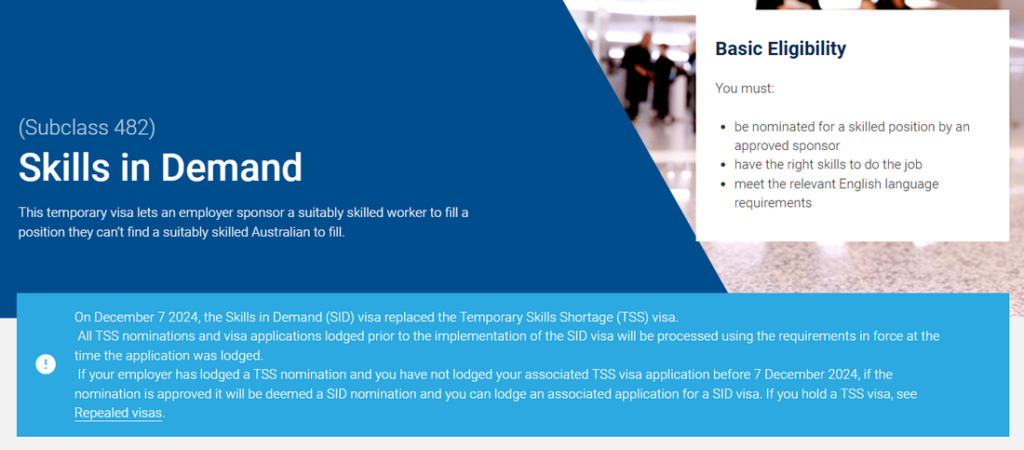
The Core Skills stream allows employers to bring skilled workers to the country from overseas if the occupation is on the Core Skills Occupation List (some examples include hospitality managers, cooks, enrolled nurses, mechanical engineers and hairdressers, to name just a few). You also need to have at least 1 year of relevant experience, have a completed skills assessment (if required) and meet the minimum English proficiency level.
The Specialist Skills stream focuses on sponsoring workers with skills that can’t appropriately be found and filled by an Australian worker. For this stream, you have to be nominated to work in an Australian and New Zealand Standard Classification of Occupations (ANZSCO) occupation listed in Major Groups 1,2,4,5 or 6 (ie Managers, Professionals, Community and Personal Service Workers, Clerical and Administrative Workers, or Sales Workers) with a salary that meets the Specialist Skills Income Threshold. As with the Core Skills stream, you also need at least 1 year of experience, a skills assessment (if required) and appropriate English proficiency.
Finally, the Labour Agreement stream is for workers nominated by businesses who have a Labour Agreement. Labour Agreements are agreements between the Australian government and employers, where the employer receives concessions to the skilled visa criteria that need to be met by applicants.
What this means for you, is that even if you don’t meet English, work experience, salary or age requirements for this work visa, you may still be eligible if the business sponsoring you has this Labour Agreement. Which is good news for you! As with all previous streams, you must also have 1 year of relevant experience, skills assessment (if required) and appropriate English proficiency, unless exempt.
With this visa, if you meet all eligibility requirements, you can apply for a permanent visa.
Subclass 485 – Temporary Graduate Visa
For international students who have recently graduated from an Australian educational institution. There are 3 streams: Post-Vocational Education, Post Higher Education, Second Post Higher Education steam, allowing you to live, study and work in Australia temporarily while gaining work experience. It’s important that you apply for the correct stream, as it’s not possible to change streams after you apply.
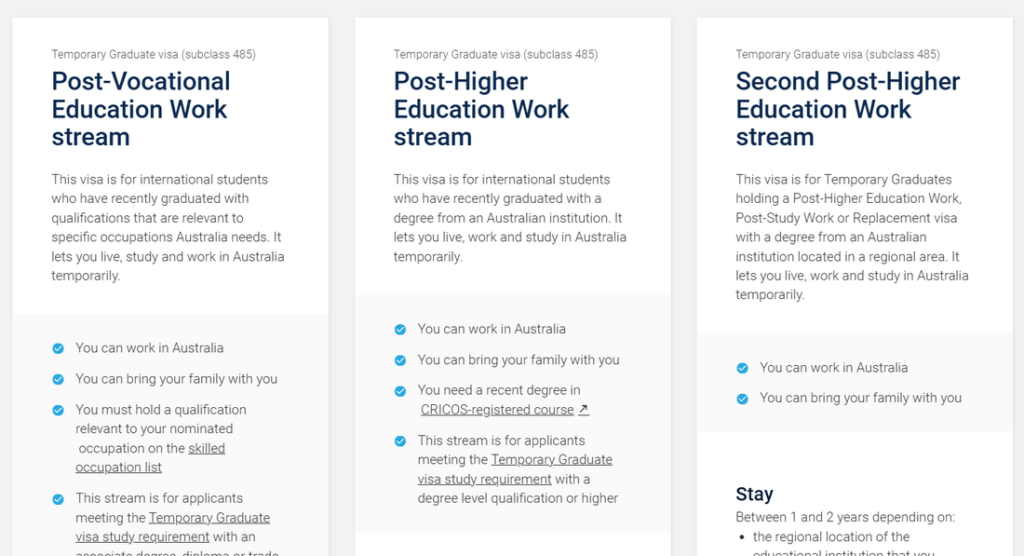
The Post-Vocational Education Work stream is for international students who have recently graduated with qualifications that are relevant to specific occupations Australia needs. Similarly to visa 482, you need to have qualifications that are relevant to an occupation on the CSOL (Core Skills Occupation List). In order to be eligible, you should also be under 35 years of age when you apply.
The Post-Higher Education Work stream is for international students who have graduated with a degree from an Australian institution. The degree needs to be in a CRICOS-registered course (Commonwealth Register of Institutions and Courses for Overseas Students). As with the Post-Vocational stream you should be under 35 years old at time of application.
Finally the Second Post-Higher Education Work stream is for Temporary Graduates holding a Post-Higher Education Work, Post-Study Work or Replacement visa with a degree from an Australian institution located in a regional area. This work visa may allow you to stay for 1-2 years in Australia, depending on the location of the institution you graduated from, and/or the regional area you live in as the holder of a Temporary Graduate visa. To be eligible, as with the previous stream, you need to have a degree in a CRICOS course, and have lived in a regional area for at least 2 years before applying.
Skilled Migration Visas
Subclass 189 – Skilled Independent Visa
This is a permanent work visa for skilled workers who are not sponsored by an employer or family member. You need to have skills in an occupation listed on the relevant skilled occupation list.
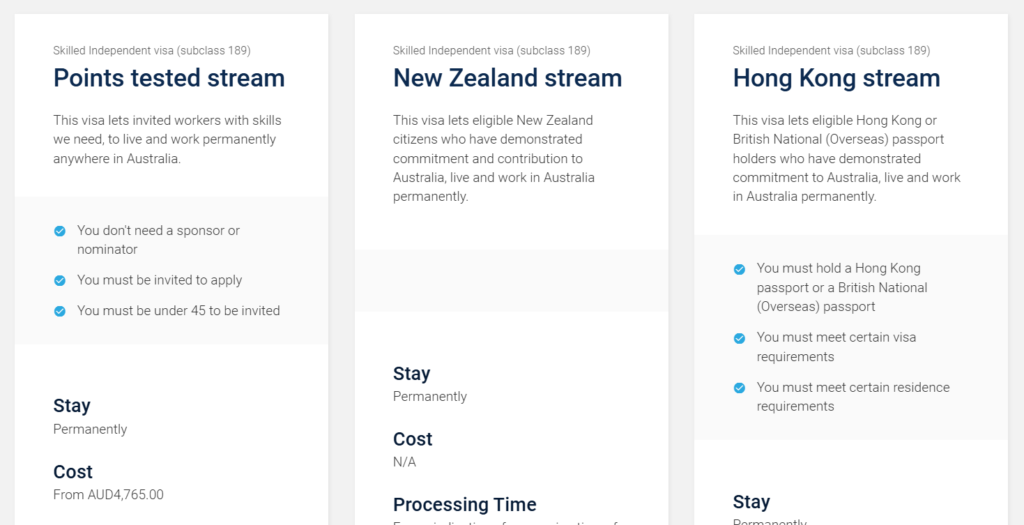
There are 2 streams available for this visa – Points tested and Hong Kong stream. The New Zealand stream, as pictured above, permanently closed to new applications on July 1st 2023.
The Points tested stream lets invited workers with skills needed in Australia live and work permanently. The big benefit of this work visa is that you don’t need a sponsor, however there is also a very significant downside – you can’t directly apply for this visa. It works by you submitting an EOI (expression of interest), and waiting for an invitation to apply for this work visa.
And while it might be logical to think that the more points you have, the higher your chances of being invited, this is unfortunately not the case. Visas are granted based on a lottery system, and there have been many cases in the past where an applicant with a low score got an invitation, and an applicant with a very high score did not. Which means that while this work visa is “easy”, it’s certainly not guaranteed.
If you’re determined to move to Australia and don’t want to leave your future to chance, this stream is probably not the right choice (please note: this is an opinion, not immigration advice. For professional immigration advice we can recommend SALIA Lawyers & Associates, who have helped us with our permanent visas and citizenship applications).
The Hong Kong stream allows, as the name suggests, eligible Hong Kong (or British National (Overseas)) passport holders who have demonstrated commitment to Australia to live and work here permanently. Besides your passport, you must have been living in Australia for at least 4 years immediately before you apply.
Subclass 190 – Skilled Nominated Visa
A permanent work visa for skilled workers nominated by a state or territory government. Applicants must have skills in an occupation on the Core Skills Occupation List and have a positive skills assessment (if applicable).
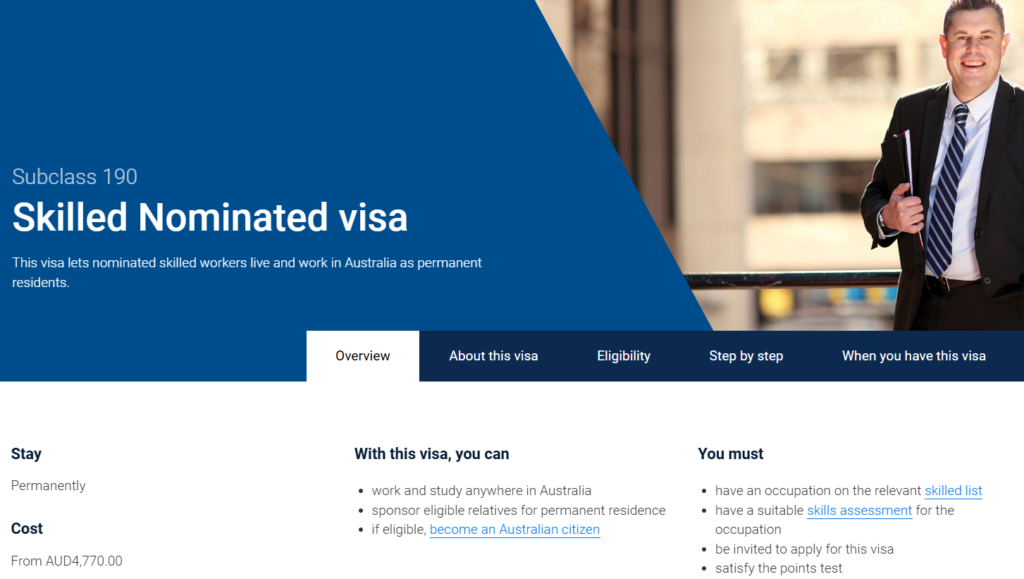
As with the Skilled Independent visa 189, you can’t directly apply for this work visa. You instead have to submit an EOI (expression of interest) and wait to be nominated to apply for the visa by a state or territory government. Note here that all state and territory government agencies have their own criteria for deciding who they will nominate. Contact the state or territory agency directly to find out more about their nomination process and what they want from you.
- New South Wales
- Victoria
- Queensland
- Australian Capital Territory
- South Australia
- Western Australia
- Tasmania
- Northern Territory
If the state or territory agency that nominates you withdraws your nomination after you have applied, your application will become invalid.
Subclass 491 – Skilled Work Regional (Provisional) Visa
A provisional work visa allows skilled workers to live and work in designated regional areas for up to five years. It requires nomination by a state or territory government, or sponsorship by an eligible family member.
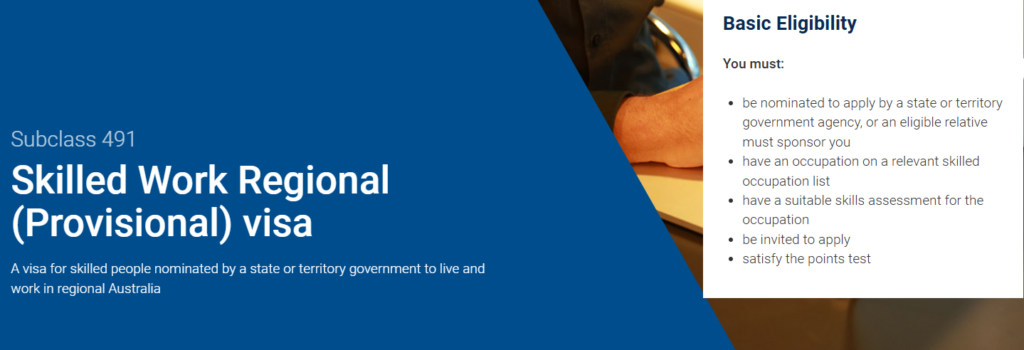
The family sponsor option for this visa makes it easier and more accessible for people that already have family in Australia. Otherwise, if you’re applying for the state to sponsor you, you need to go through the same EOI/nomination/application process as with the previous 2 visas.
Another special provision with this work visa is the Subsequent Entrant visa, which applies to a family member of someone who already has the Skilled Work Regional 491 visa – this is their only eligibility criteria.
Employer-Sponsored Visas
Subclass 186 – Employer Nomination Scheme (ENS) Visa
This permanent work visa allows skilled workers nominated by an approved Australian employer to live and work in Australia indefinitely. There are multiple streams here, including: direct entry, labour agreement, and temporary residence transition stream (if you currently hold a temporary visa).
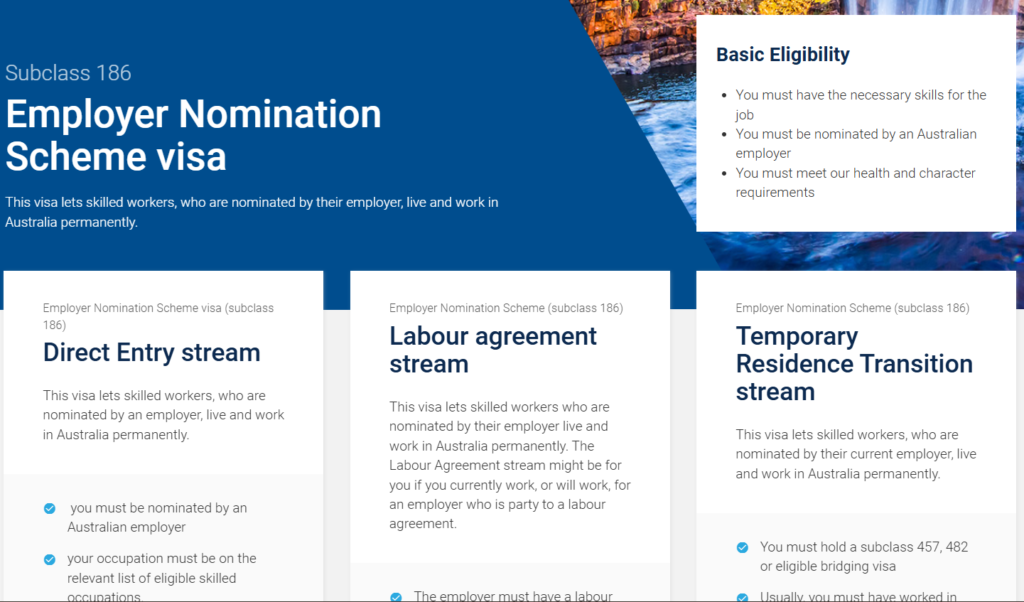
The direct entry (DE) stream allows skilled workers to be sponsored by an employer if they meet the eligibility criteria, including being nominated for an occupation on the Core Skills Occupation List. You also need at least 3 years relevant working experience, have a skills assessment and have adequate English skills.
The Labour Agreement stream might be for you if you currently work, or will work, for an employer who holds a labour agreement with the government. Labour Agreements are deals between Australian employers and the government that relax some work visa rules. So even if you don’t tick all the boxes for English, experience, salary, or age requirements, you might still qualify if your sponsoring employer has one of these agreements.
The Temporary Residence Transition stream is for applicants who already have a temporary 482 Skills in Demand visa. A typical condition for this visa is that you’ve worked in sponsored employment on your 482 visa for at least 2 years full time to apply for the permanent 186 visa.
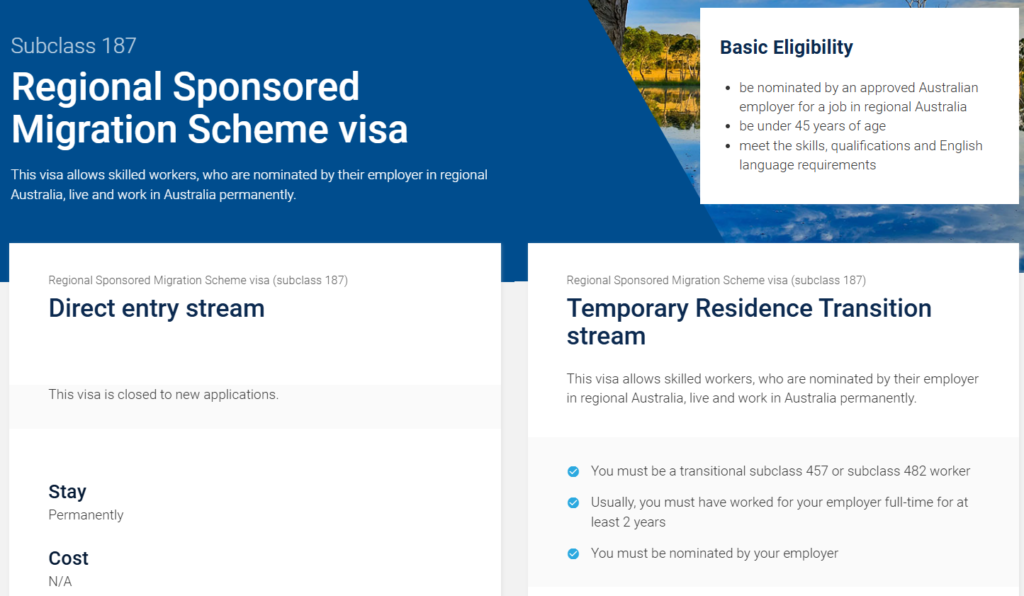
Subclass 187 – Regional Sponsored Migration Scheme (RSMS) Visa
This is a permanent work visa for skilled workers who are nominated by an employer in a regional area of Australia. At this time, the only viable stream is the Temporary Residence Transition stream, meaning you have to already be in Australia on another visa to transition to this visa.
But don’t let this stop any of your plans! Visa conditions and availability (and even visa names!) change regularly, so while we do our best to keep everything here up to date, it’s always a good idea to check the DOHA (Department of Home Affairs) website for latest updates (conveniently linked for you above to this specific visa).
To apply for the Temporary Residence Transition stream, you need to already hold the 482 temporary visa, or be on another substantive or Bridging visa (A, B or C). A typical condition is also to have worked for your employer in regional Australia for at least 2 years while on the 482 visa. As this is a sponsored work visa, an eligible employer must nominate you, and be approved, prior to you applying.
Business and Investment Visas
Subclass 888 – Business Innovation and Investment (Permanent) Visa
For individuals who have held a provisional Business Innovation and Investment visa (subclass 188) and wish to continue business operations or make investments in Australia.
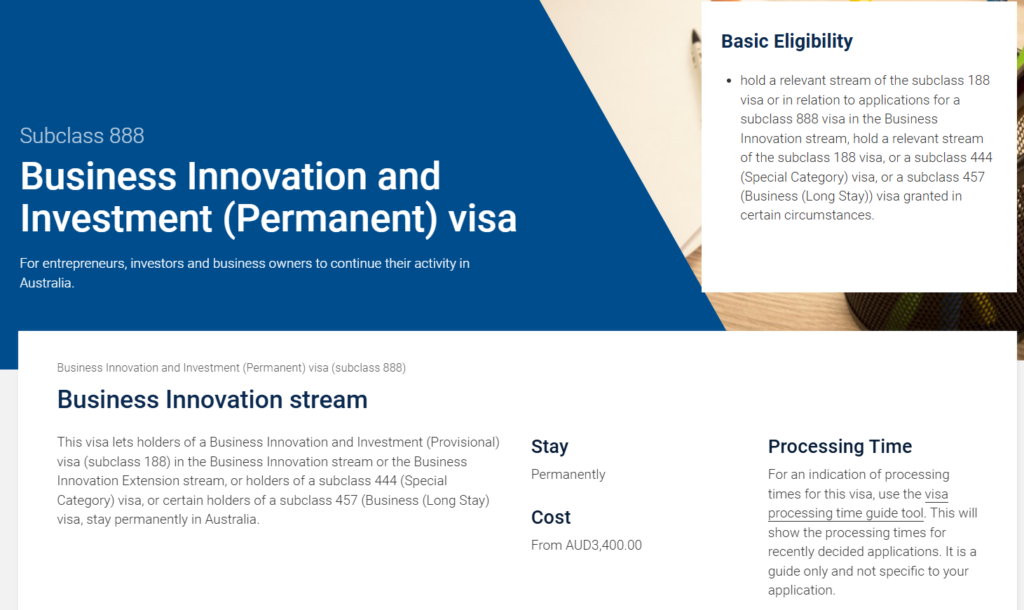
To get visa 188 (provisional, you’ll need this first), you have to submit an Expression of Interest (EOI) and be either nominated by a state/territory government, and/or be invited to apply for the visa. To get visa 888 (permanent), you’ll have to already hold the provisional 188 visa.
As the name suggests, you have to operate a new or existing business in Australia, or invest the required amount in Australia investments to be considered for this work visa.
Keep in mind there are also numerous streams for this visa (business innovation, investor, significant investor, premium investor, and entrepreneur), meaning that there are many different options and opportunities for you based on your circumstances.
Working Holiday Visas
Subclass 417 – Working Holiday Visa
For individuals aged 18 to 30 (inclusive) from eligible countries, or 35 years old from some countries. This work visa allows you to holiday and work in Australia for up to 12 months. Another requirement is you must not be accompanied by children. You can apply for this visa up to 3 times.
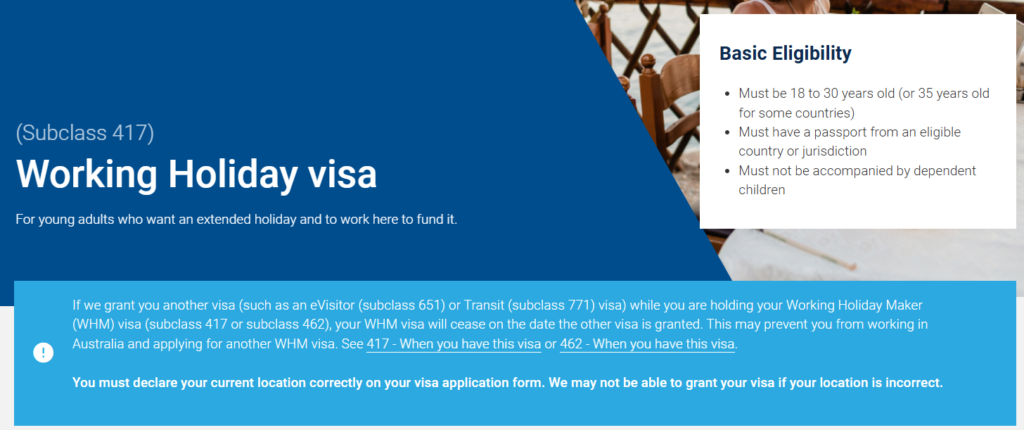
The first Working Holiday visa lets people 18 to 30 years old (or 35 years old for some countries) have their first extended holiday in Australia and work here to help fund their trip. You can also study for up to 4 months while you’re here.
An important criteria for this work visa are your funds. You need to have enough money to support yourself while in Australia, and to leave at the end of your stay. This is usually about AUD $5,000, plus the flights to where you’re going after you leave Australia.
Below is the list of approved countries/jurisdictions you can apply from (you must hold a passport from this country):
- Belgium
- Canada
- Republic of Cyprus
- Denmark
- Estonia
- Finland
- France
- Germany
- Hong Kong Special Administrative Region of the People’s Republic of China
- Republic of Ireland
- Italy
- Japan
- Republic of Korea
- Malta
- Netherlands
- Norway
- Sweden
- Taiwan (other than an official or diplomatic passport)
- The United Kingdom of Great Britain and Northern Ireland (including British National Overseas passport holders)
Important: Do not arrange travel to Australia before you have received your visa in writing.
If during your first WH visa you completed 3 months of specified work, you may be eligible for your second WH visa.
What is specified work, you might be asking? The following industries are approved for specified work:
- tourism and hospitality in Northern or Remote and Very Remote Australia, from 22 June 2021
- All specific postcodes and areas that are considered remote and very remote can be found here.
- plant and animal cultivation in regional Australia
- fishing and pearling in regional Australia
- tree farming and felling in regional Australia
- mining in regional Australia
- construction in regional Australia
- bushfire recovery work in declared bushfire-affected areas carried out after 31 July 2019
- recovery work in flood, cyclone, or other severe weather-affected areas carried out after 31 December 2021
- critical COVID-19 work in the healthcare and medical sectors anywhere in Australia, after 31 January 2020
If you’re looking for some guidance on what kind of job you can get as a temporary resident, you can check out our guide on the best jobs for international students: the work criteria is very similar, after all!
In order to get a third WH visa, you must have completed at least 6 months of specified work on your second WH visa
Subclass 462 – Work and Holiday Visa
Similar to the 417 visa, but for citizens of specific countries. To be eligible, alike the 417 work visa, you have to be between 18 – 30 years old and must not be accompanied by children.
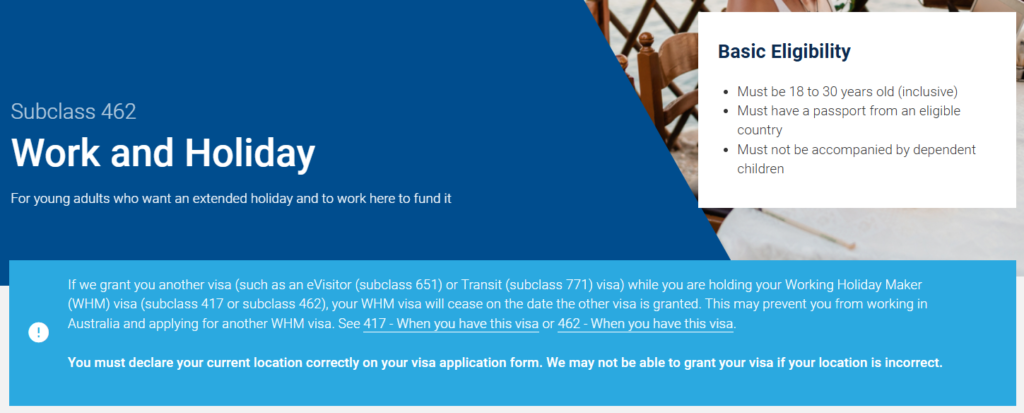
You can apply for this visa if you hold a passport from one of the below countries:
- Argentina
- Austria
- Brazil
- Chile
- China, People’s Republic of
- Czech Republic
- Ecuador
- Greece
- Hungary
- India
- Indonesia
- Israel
- Luxembourg
- Malaysia
- Mongolia
- Papua New Guinea (PNG)
- Peru
- Poland
- Portugal
- San Marino
- Singapore
- Slovak Republic
- Slovenia
- Spain
- Switzerland
- Thailand
- Türkiye
- Uruguay
- United States of America
- Vietnam
Please note: China, India and Vietnam passport holders must participate in a visa pre-application process (ballot) and be randomly selected in the ballot to apply for a first Work and Holiday (subclass 462) visa.
A big requirement for this work visa are also your funds. You need to have enough money to support yourself while in Australia, and to leave at the end of your stay. This is usually about AUD $5,000, plus the flights to where you’re going after you leave Australia.
As with the 417 visa, you can apply for 3 WaH visas. To be eligible for your second WaH visa, you need to complete 3 months of specified work, and to apply for your third, you need to complete 6 months of specified work. The requirements for specified work are the same as for visa 417 above.
Considerations When Applying for Work Visas
- Eligibility Requirements: Each work visa type has specific eligibility criteria, including language proficiency, health assessments, character assessments, and skills assessment, to name a few. Certain visas require that you already have another specific visa, or vice versa, require that you have not held a specific visa before. Each visa is very unique, so if you’re considering applying for a number of different work visas, make sure you check each single one and understand all eligibility requirements to make sure you apply for the best visa for your circumstances.
- Skills Assessment: For skilled work visas, you’ll often need to undergo a skills assessment by a relevant assessing authority to ensure your qualifications meet Australian standards. Most occupations have their own skills assessing authority, with each having their own assessment procedures, frameworks and charges. For example, Engineers Australia provide skills assessment services ranging from (at the time of writing) $324.50 to $1,694 depending on complexity, while the Australian Computer Society Inc (ACS) charges anywhere between $500 and $1,450, based on the service. The authority you choose to get your skills assessment from must of course correspond with your experience and the work visa you’re applying for.
- Recognition of Prior Learning (RPL): This is a process that assesses your competency/skills that you gained through either formal (certificate, diploma, university), non-formal (in-house training provided by a business) or informal (work-related, hobby or leisure experience) learning, to determine if this learning is equivalent to a course provided in Australia.
- Gathering Documents: The documentation required varies depending on the work visa subclass. Remember that all documents that are not originally in English need to be translated by a sworn translator before they can be used as evidence for your visa. Some documents you’ll need for almost all visas include:
- Passport: A valid passport with at least six months’ validity beyond your intended stay in Australia.
- Visa Application Form: Completed visa application form specific to your visa type. Forms are available on the Department of Home Affairs website, with most being available as online forms only.
- Identity Documents: Birth certificate, national identification card, or other official identification that establishes your identity.
- Skills Assessment: For skilled work visas, you may need to provide a positive skills assessment from the relevant assessing authority for your occupation.
- Qualifications: Certified copies of your educational qualifications, including degrees or diplomas.
- English Language Proficiency: Evidence of English language ability (e.g., IELTS, TOEFL, or PTE scores), if required for your visa type.
- Employment History: Detailed CV/resumé highlighting your work experience, including reference letters from previous employers if applicable.
- Health Insurance: Documentation of health insurance coverage for the duration of your stay in Australia.
- Health and Character Requirements: You may need to undergo health examinations and provide police clearance certificates as evidence of your character.
Seek Professional Advice
Please remember none of the above is legal advice! If you’re unsure about which work visa is best for your situation, consider consulting an immigration lawyer (why not a migration agent?) who can provide professional, tailored advice based on your circumstances.
We recommend SALIA Lawyers & Associates, who helped us with our visas, all the way from first moving to the country to now being permanent residents and citizens!
Conclusion
Navigating the various work visa options in Australia can seem confusing, but understanding the different categories and their requirements is the first step toward making your dream of working in Australia a reality. From Temporary Work to Skilled Migration and Employer-Sponsored Visas – and more! – each pathway offers unique opportunities tailored to different skills and experiences.
Australia is a land of opportunity, and with the right visa, you can contribute your skills and talents while experiencing the vibrant culture and lifestyle the country has to offer.
Good luck—you’ve got this!
